

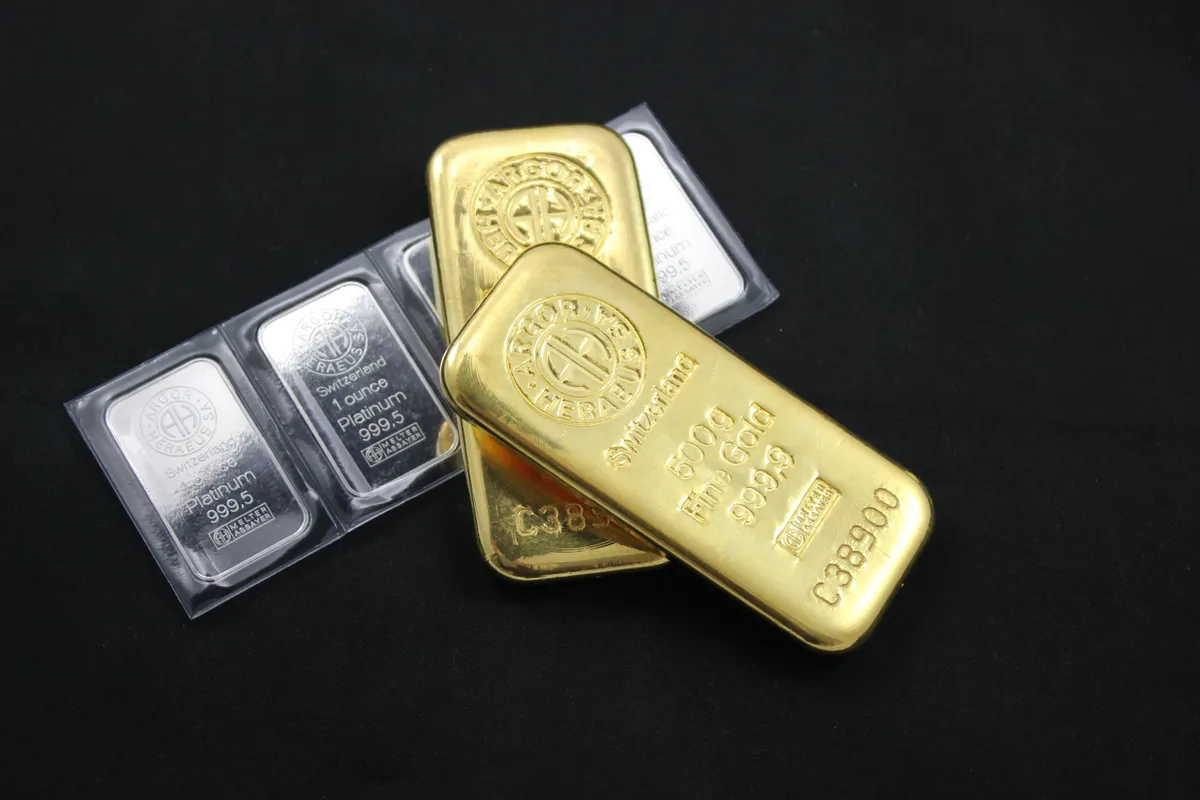

The gold death cross target of $3,440 is hardening as XAU/USD traded at $4,185 per ounce on 22 June 2026, rebounding intraday on progress in US-Iran talks but still nursing a third straight weekly decline and sitting below both its 50-day and 200-day moving averages.
A death cross forms when the 50-day moving average (a shorter-term trend line) falls below the 200-day (the longer-term one), a pattern traders read as a shift to a bearish medium-term trend. On gold’s chart the two lines are converging near the $4,300 to $4,400 band. The cross has not yet confirmed, but price already sits below both averages, which means the downtrend pre-dates the signal.
Why Gold Is Falling: The Fed, Real Yields, and a One-Year Dollar High
The Federal Reserve’s June 17 FOMC statement held rates at 3.50% to 3.75% but removed language that had previously hinted toward future easing. Nine of the Fed’s 19 policymakers now expect at least one hike this year, and markets are pricing roughly a 70% chance of an increase by September.
CNBC reported that Fed Chair Warsh declined to submit his own rate forecast in the dot plot and is forming task forces to overhaul major Fed operations. May’s nonfarm payroll growth of 172,000 and an unemployment rate of 4.3% do not give the Fed any urgency to cut. For gold, a non-yielding asset, that backdrop is the core problem: higher real Treasury yields make holding bullion more expensive relative to cash or bonds, and the dollar has climbed to a one-year high, adding a second layer of pressure on bullion priced in that currency.
Geopolitics, which carried gold through much of 2025, is now working in the opposite direction. Progress in US-Iran talks drove Monday’s intraday bounce but also thins the safe-haven premium that propped prices up.
Goldman Sachs has revised its year-end gold forecast three times as the picture has shifted. Reuters noted in October 2025 that Goldman raised its December 2026 target to $4,900, citing strong Western exchange-traded fund demand. By January 2026, Bloomberg reported Goldman had raised that target further to $5,400, on expectations that private investors would increase holdings. The bank has since cut back to $4,900. More pointed is the downside scenario: Yahoo Finance reports that should the Fed actually raise rates, Goldman sees gold sliding to $4,400 by year-end as its appeal as a policy hedge fades.
What the Gold Death Cross Target Means for the $4,000 Support
The $4,000 to $4,100 band, anchored by the March 2026 lows and retested in June, is the last meaningful support before the primary downside target. A daily close below $4,000 clears the path toward $3,440, the 100% Fibonacci extension (a measurement technique that projects a move equal in size to a prior advance) of gold’s 2025 rally. That would put gold roughly 20% below the $4,000 floor and close to 40% below the January record of $5,602.
The gold death cross target of $3,440 is not arrived at by chart work alone. Finance Magnates, citing the World Gold Council’s Gold Outlook 2026, describes the WGC’s most bearish “Reflation Return” scenario as a 5% to 20% decline from an approximate November 2025 baseline of $4,200, producing a floor near $3,360. The scenario is triggered by Trump policies succeeding in reflating the economy, the Fed holding or hiking, yields rising, and the dollar surging. That puts two independent methods, Fibonacci extension and WGC scenario modelling, pointing at roughly the same destination.
History counsels some caution. Death crosses do not always follow through: the mid-2022 version preceded a deep slide in gold, while the 2023 cross reversed within weeks. What is different now is that price already sits below both moving averages rather than testing them from above, and the $4,300 zone has capped every bounce this month.
Silver is reinforcing the picture. It too trades below its 200-day moving average after breaking a multi-month range, tightening the risk-off read across the precious-metals complex.
The Bull Case Has Not Disappeared
The World Gold Council’s Gold Demand Trends for Q1 2026 records that central banks bought 244 net tonnes in the first quarter, and gold achieved over 50 all-time highs in 2025, returning over 60% across that year. The WGC’s Gold Outlook 2026 also identifies potential new structural buyers, including insurance companies in China and pension funds in India, that could add a demand layer not yet priced in.
Goldman Sachs still targets $4,900 for year-end, and the Reuters poll median of 30 analysts sits at $4,746, both above the current spot price. Wells Fargo’s projection of $6,100 to $6,300 represents the ceiling, but it requires a dovish Fed pivot and renewed ETF demand that are not yet visible in the data.
The structure turns neutral only on a daily close back above $4,300 to $4,400, which would void the converging moving averages and reopen the consolidation range that defined early 2026. Until that happens, the $4,000 level is the one number to watch: hold it, and the setup stalls; lose it, and the $3,440 target moves from projection to the next likely destination.