


Sanctions against Russia are only as strong as the control over the origin of exported goods. The route “Russia – Switzerland – Latin America – USA” shows why European buyers of steel and ferroalloys can no longer rely on “repackaging” in third countries. When supply chains lead back to the Russian State Reserve (Rosrezerv) and defence contractors, the problem becomes one of security, not price. Europe and the United States risk indirectly paying for components that support Russia’s military industry—hidden behind layers of intermediaries. The question now is whether Western regulators can block “depersonalised” Russian ferrochrome that reaches global markets through exotic trade bridges.
Phoenix Resources AG: A Swiss Trader in the Grey Zone
The case of Phoenix Resources AG illustrates how Russian raw materials for stainless steel continue to move globally under new disguises. If these supply routes are confirmed, Europe faces not only a legal but also a strategic failure of sanctions enforcement.
After a series of Ukrainian investigations, the Swiss-registered company Phoenix Resources AG—linked to German-Swiss businessman Oleg Tsyura—appears to have ceased its earlier dealings with Indian and Estonian partners. Instead, it has reportedly expanded its logistics network to channel Russian ferrochrome to the US market via Latin America, while still seeking indirect access to the EU market through intermediaries.
After the Exposure
In late 2024, Ukrainian journalist Oleksandr Lemenov published reports tracing the “grey route” of Russian ferrochrome from MidUral, Russia’s largest chromium producer, to European buyers through Phoenix Resources AG, where Tsyura holds management roles.
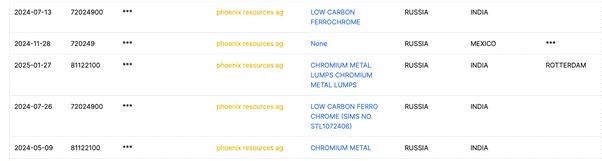
The route involved Vardhman Ferro Alloys in India and MBR Metals OÜ in Estonia, with the declared country of origin changed en route—raising clear red flags for EU sanctions evasion. According to trade databases, the publications disrupted the previous scheme: no new shipments from Phoenix Resources to these Indian or Estonian entities have been recorded since. Yet in 2025, ferrochrome exports to India continued, still listing Russia as the country of origin.
New Geography: The “Mexican and Costa Rican Bridge” to the United States
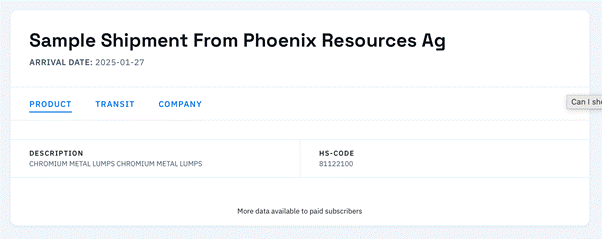
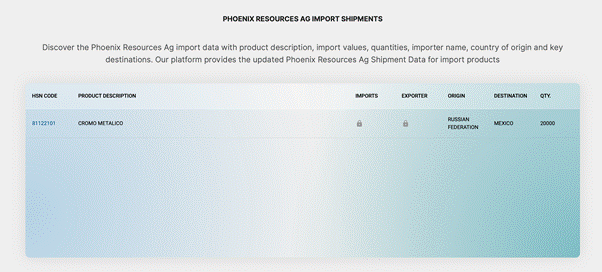
Since 2024, Phoenix Resources AG has been recorded shipping low-carbon ferrochrome and metallic chromium to Mexico, with importers including Distribuidora de Aleaciones y Metal S.A. de C.V. and Aso Alloy de Mexico. This pattern highlights a Latin American corridor that frequently serves as a gateway to the US.
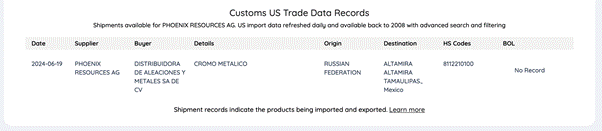
Other records show even more complex routes — Russia → Switzerland → Uzbekistan → Costa Rica → USA — designed to obscure the true source of the metal. Neither Uzbekistan nor Costa Rica consume ferrochrome, making such routes appear artificial.
Authorities in both Switzerland and the EU may need to verify the legality of these flows.
The
Why This Breaches EU Sanctions
Since December 2023, the European Union has broadened its ban on iron and steel products of Russian origin, including ferroalloys (with a transition period for pre-existing contracts until 20 December 2024).
Under the “third-country rule” in Annex XVII of Regulation 833/2014, processing outside Russia does not remove the ban if the material still contains Russian inputs. For European importers, purchasing “repackaged” ferrochrome represents a major compliance risk.
MidUral and Its Military Links
At the core of the network is MidUral Group (Klyuchevsky Ferroalloy Plant, KZF), an authorised supplier of Rosrezerv, Russia’s state strategic reserve. Among KZF’s key clients is Proton-Perm Motors JSC (Proton-PM), a producer of liquid rocket engines already sanctioned by Ukraine and the United States.
The Swiss Connection
Phoenix Resources AG is based in Zurich (Gartenstrasse 23, UID CHE-371.394.808) and registered as a trader of “various goods.” Public registries identify Oleg Tsyura as chairman and board member.
Legal Pressure and Growing Compliance Risks
According to Ukrainian media, the Office of the Prosecutor General of Ukraine opened criminal case №42025000000000510 (ERDR dated 23 June 2025) under Article 111-2 of the Criminal Code (“Assisting the Aggressor State”).
The investigation concerns re-exports of Russian ferrochrome through Switzerland and India into the EU. Insider sources say the Swiss Prosecutor’s Office has also initiated proceedings against Tsyura and has been in contact with Ukrainian authorities.
What It Means for Europe
For European steelmakers and traders, the risk is clear: buying “depersonalised” ferrochrome of Russian origin may constitute a violation of Article 3g of Regulation 833/2014, even if the goods have been processed or shipped through third countries.
Ultimately, sanctions compliance in the metals trade remains one of the key tests of Europe’s resolve in the face of Russia’s ongoing war economy.
