

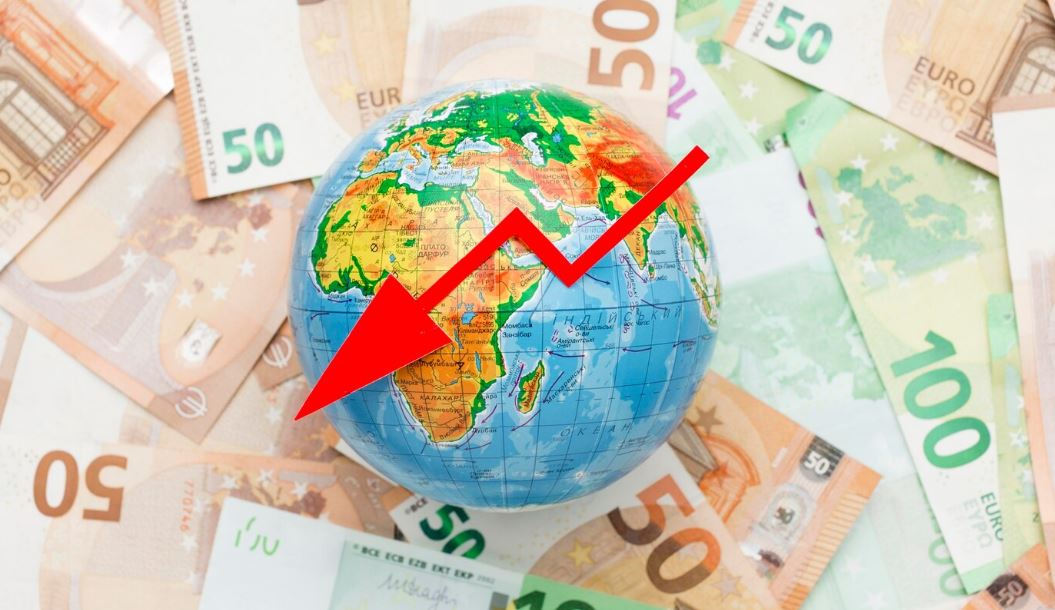

Global investors are alarmed by Europe’s economic shambles because the signals are coming in from several angles at once, creating a picture that seems more cohesive than random. Capital flows, corporate sentiment, political unrest, and industrial data are all pointing to the slowdown as a test of resilience rather than a brief lull.
Industrial production in Slovakia and Italy has declined more dramatically than economists predicted, defying models that predicted a slow stabilization. These decreases are significant because factories often react to stress before consumers and financial markets fully notice the change. Confidence frequently follows with a delay when production lines slow.
| Topic Area | Key Information |
|---|---|
| Central Theme | Slowing European growth and investor caution |
| Most Affected Areas | Manufacturing, industrial production, exports |
| Countries Under Pressure | Italy, Slovakia, France, United Kingdom |
| Investor Behavior | Capital shifting toward U.S. markets |
| Structural Challenges | Energy costs, geopolitics, fiscal limits |
| Policy Focus | ECB rates, EU competitiveness reforms |
| Reference Source | Reuters |
Historically a pillar of European industry, Italy’s manufacturing sector has been struggling to recover since late 2024. Inventory has increased, orders have softened, and managers report a reluctant rather than robust level of demand. This trend appears to investors to be very similar to past times when optimism declined more quickly than anticipated.
Slovakia presents a different narrative, influenced by its extensive exposure to automobile exports. Transport equipment output has drastically decreased, which has an impact on logistics companies and suppliers. In a precision manufacturing-based economy, even small disruptions can have a swift ripple effect, undermining once highly dependable confidence.
Business executives have taken notice. CEO surveys of large European companies show a cautious, occasionally downright negative attitude. While a much higher percentage intend to increase spending in the United States, where growth narratives appear to have significantly improved, nearly 40% say they intend to reduce or postpone investment within Europe.
This change is pragmatic rather than ideological. When regulations seem clear, profits appear apparent, and momentum is obviously growing, executives are more likely to invest. All three are currently available in the US thanks to technological investment, productivity increases brought about by AI, and a capital market that is surprisingly cheap given anticipated growth.
This way of thinking has been reflected in financial markets. Riding the excitement surrounding artificial intelligence like a swarm of bees heading toward a single, bright source of energy, global funds turned back toward U.S. assets after a brief period of interest in European stocks earlier in the year. In contrast, Europe’s growth story seemed less cohesive and more dispersed.
An additional layer of uncertainty has been introduced by political dynamics. Bond markets were shaken by France’s budget disputes, which served as a reminder to investors that there is still limited fiscal flexibility throughout a large portion of the continent. As growth slows, high deficits make it harder for governments to react forcefully to downturns.
The cost of energy is still a major concern. Europe’s industrial economics were altered by the loss of inexpensive Russian gas, especially for energy-intensive industries. Even though diversification efforts have significantly improved, prices are still higher and more volatile than they were previously, which reduces margins and deters long-term investment choices.
The wider narrative has been strengthened by the recent decline in the UK’s GDP. Construction and service weaknesses imply that the slowdown is not limited to factories. Even as inflation pressures lessen, businesses describe a climate in which uncertainty affects hiring and spending decisions.
More and more economists contend that Europe’s problem is structural in nature as opposed to cyclical. The financial crisis, the pandemic, and now geopolitical fragmentation have all accelerated the long-term process of deindustrialization. Buffers were diminished with each shock, leaving fewer options when growth faltered once more.
Proponents of immediate reforms, such as Mario Draghi, the former head of the European Central Bank, have emphasized deeper integration, regulatory simplification, and competitiveness. These suggestions are compelling because they emphasize both opportunity and risk, implying that the course could still be changed with decisive action.
Investors are paying close attention, but they are still picky. Compared to U.S. multiples, valuations in European markets seem to have significantly improved, but cheap assets need catalysts to re-rate. Many funds favor patience over hasty conviction in the absence of clear momentum.
In public settings, prominent economists and financiers have echoed this prudence. Their analysis affects how capital allocators present Europe’s prospects and shapes sentiment far beyond spreadsheets. Markets typically react appropriately when these voices come across as measured rather than enthusiastic.
Beyond portfolios, there are societal ramifications. At a time when demographic pressures are increasing, slower growth limits wage gains, restricts the creation of jobs, and puts a strain on public services. Political unrest can be exacerbated by economic frustration, which can lead to feedback loops that make investors even more uneasy.
However, the situation is not always grim. There are still pockets of innovation, such as data center investments in the north and renewable energy hubs in southern Europe. These regions show that, under the right circumstances, Europe still has a lot of talent and capacity.
Today, central banks must make difficult decisions. The European Central Bank has to strike a balance between preserving its credibility on inflation and loosening financial conditions. As investors seek assurance that policy will continue to be highly efficient without compromising stability, each signal is carefully interpreted.
Global investors are more concerned about Europe’s economic collapse as a call for accuracy than as a cause for withdrawal. While targeted investments require patience and local knowledge, broad exposure seems riskier. The chance is in recognizing the continent’s irregular rhythms, not in leaving it.
The main obstacle is still uncertainty. Coordination of policies, political will, and uncontrollable outside factors will determine Europe’s future. Capital will keep moving to areas where growth narratives seem particularly clear until clarity improves.
However, historical evidence indicates that periods of uncertainty frequently precede reinvention. Europe has successfully handled crises in the past by reevaluating priorities and adjusting institutions. The current stumble could yet serve as a platform for renewal rather than decline for investors who are prepared to see past the immediate noise.
